

How Do I Find What Shortcodes Are In A Template
WordPress shortcodes are a powerful feature to do cool stuff with little endeavor. You lot can exercise pretty much anything with them. With shortcodes, embedding interactive elements or creating complex page layouts is as easy as inserting a single line of code.
If you lot want to add a gallery, you have to simply type in the post-obit code:
[gallery ids="47 ,86, 92, 64, 48, 75, 89, fourscore" columns="4" size="medium"]
This will output a gallery with the epitome IDs mentioned. Information technology'll have 4 columns and their max size will be 'medium' (every bit defined by WordPress).
In that location'due south no need for any ugly HTML code.

Shortcodes eliminate the need for complicated scripts. Even if you have picayune to no programming skills, you lot tin add dynamic content effortlessly with their help.
They're very pop within WordPress developers, as they help immensely with automating content and design cosmos. Shortcodes are to WordPress developers what Macros are to data analysts, or Keyboard Shortcuts to professional graphic designers.
In this guide, you lot'll learn everything there is to know near shortcodes. Y'all'll find out how to work with the Shortcode API past creating your very own shortcodes. In the cease, we'll discuss the time to come of shortcodes and where they fit in with WordPress' new Block editor.
Excited? Let'southward become started!
Prefer to watch the video version?
What is a Shortcode?
In a nutshell, Shortcode = Shortcut + Lawmaking.
Typically, shortcodes utilise square brackets tags [] to ascertain how they're used. Each shortcode performs a particular function in a site. It can exist every bit unproblematic as formatting the content or equally circuitous every bit defining the entire website's construction.
For case, you can use shortcodes to embed sliders, forms, or pricing tables. Y'all can even use them to create reusable page design templates.
A Short History of Shortcodes
Shortcodes were first fabricated pop by an online forum software called Ultimate Bulletin Lath (UBB). In 1998, they introduced BBCode (Bulletin Board Code), a collection of like shooting fish in a barrel-to-use tags for users to format their posts hands.
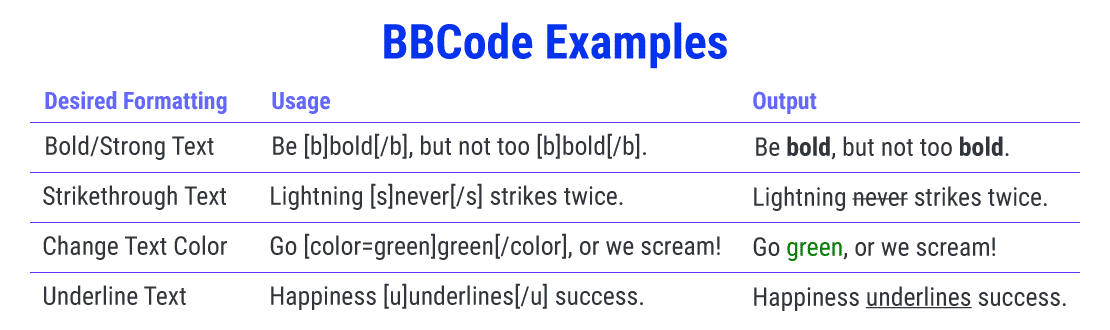
As a lightweight markup linguistic communication, BBCode works on the same principles as HTML, except it's fashion simpler.
Using predefined tags is much safer too, as users cannot insert HTML code and innovate security vulnerabilities. For instance, a user with malicious intent could apply the <script> tag to execute JavaScript code and break the site's functionality.
Soon later, other online forum software such as phpBB, XMB Forum, and vBulletin added BBCode functionality in their message boards.
Shortcodes empowered admins to have greater command over what their users can and cannot do. Plus, they allowed users to format their content through uncomplicated tags.
Due to the aforementioned security reasons, WordPress prevents PHP lawmaking from running inside site content. To overcome this limitation, WordPress ii.5 introduced the shortcodes functionality in 2008 with the release of Shortcode API. It has proven to be one of the most used features by many WordPress plugins and themes developers.
What Are WordPress Shortcodes?
WordPress shortcodes are square bracket strings ([ ]) that magically transform into something fascinating on the frontend. They requite users an easy way to create and change complicated content without worrying most complex HTML or embed codes.
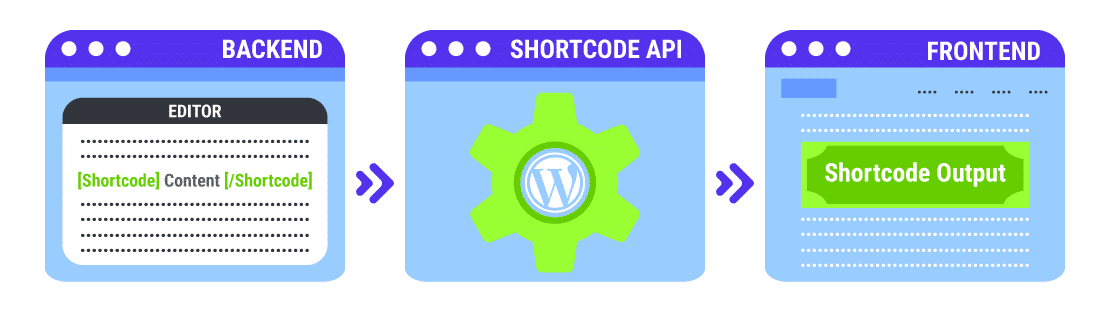
The two Types of Shortcodes
In that location are primarily ii types of shortcodes in WordPress.
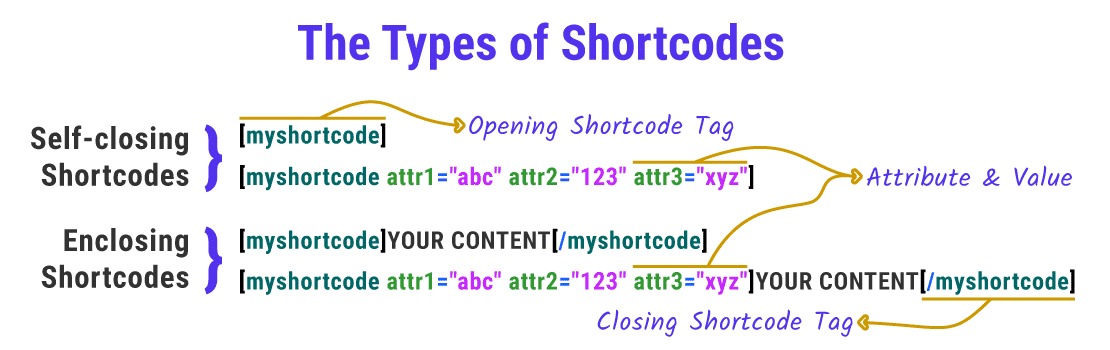
- Self-closing Shortcodes: These don't demand a closing tag.
Instance: The gallery shortcode doesn't demand a closing tag. Nosotros add everything it needs with different attributes.
- Enclosing Shortcodes: These need a closing tag. Enclosing shortcodes generally dispense the content between the opening and closing tags.
Example: The explanation shortcode is used to wrap a caption around any content. Information technology's mainly used to add a caption to images, but information technology works with whatsoever HTML chemical element.
Some shortcodes piece of work with or without attributes. It depends on how they're defined.
The Default WordPress Shortcodes
WordPress comes with half-dozen default shortcodes:
-
- audio: Embed audio files on your website. It includes simple playback controls like Play & Pause.
- caption: Wrap captions around your content with it. It's generally used to add prototype captions, but y'all can use information technology for any HTML chemical element.
- embed : Expand on the default oEmbed feature. This shortcode lets yous set different attributes to your embeds, like setting their max dimensions.
- gallery : Insert a simple image gallery on your site. You can utilise attributes to ascertain which images are used and customize how the gallery looks.
- playlist : Display a collection of audio or video files with this self-enclosing shortcode. You lot can give information technology a cool 'dark' mode with its style aspect.
- video: Embed a video file and play it back using a unproblematic video player. This shortcode supports embedding videos with these formats: mp4, webm, m4v, webm, ogv, wmv, flv.
For more details most how you tin can utilize the default shortcodes and what attributes they support, you can refer to the linked Codex docs.
How to Use WordPress Shortcodes
Using shortcodes in WordPress is a straightforward process. Only it depends on where you want to add together them on your site. Brand certain to read the shortcode documentation to understand how information technology works. Learn the attributes it supports, so yous tin can go precisely what yous want.
Using WordPress Shortcodes in Pages and Posts
First, become to the page/post editor where you want to insert the shortcode.
If yous're using the Gutenberg editor, y'all tin add together the shortcode tag in the standalone Shortcodes block. Nosotros tin can detect it in the Widgets section.
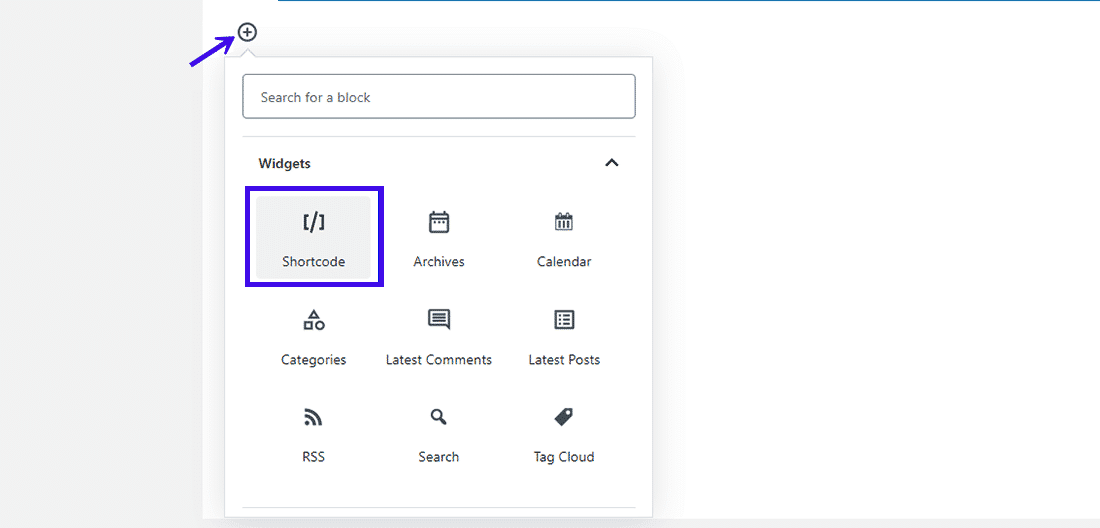

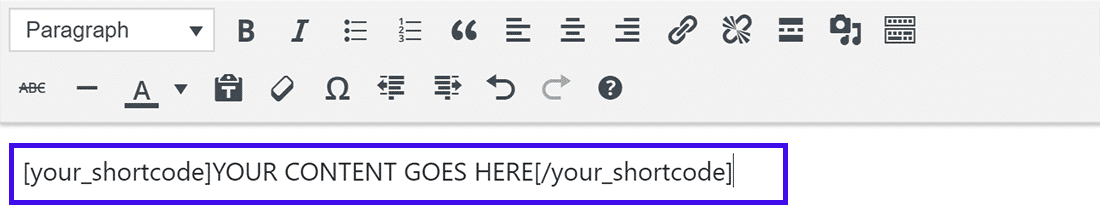
Still using the Classic Editor (or the plugin)? You can type in your shortcode tags the classic fashion. A few shortcodes may fifty-fifty have a button in the editor screen to insert them readily.
Using WordPress Shortcodes in Sidebar Widgets
Shortcodes can also exist inserted in sidebar widgets. To add together them, go to Advent » Widgets and add a Text widget to the section where you want to add together the shortcut.
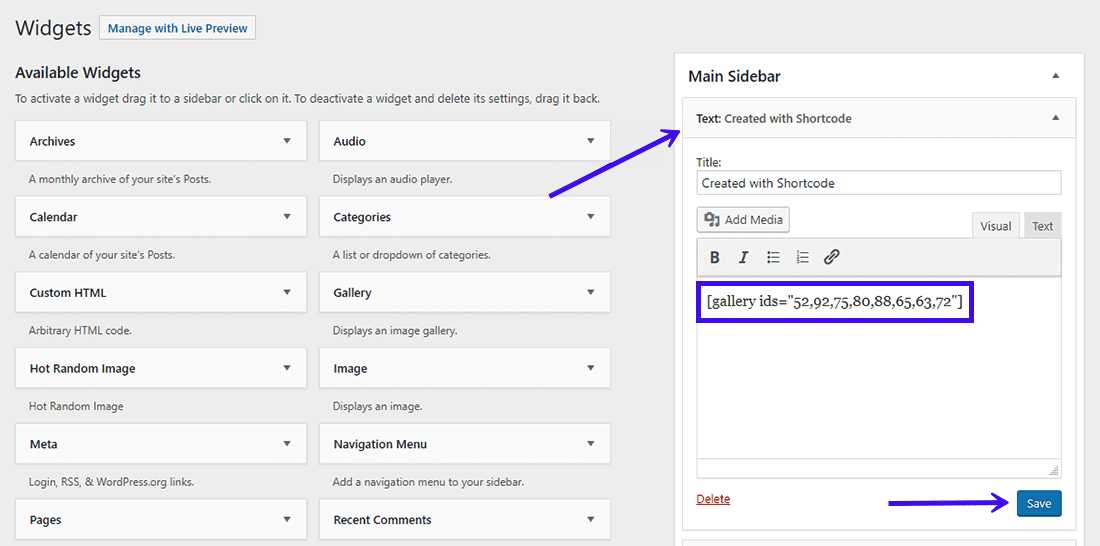
Paste the shortcode inside the Text widget and Save it. You tin can visit your site'southward frontend and see the shortcode's output in your sidebar.
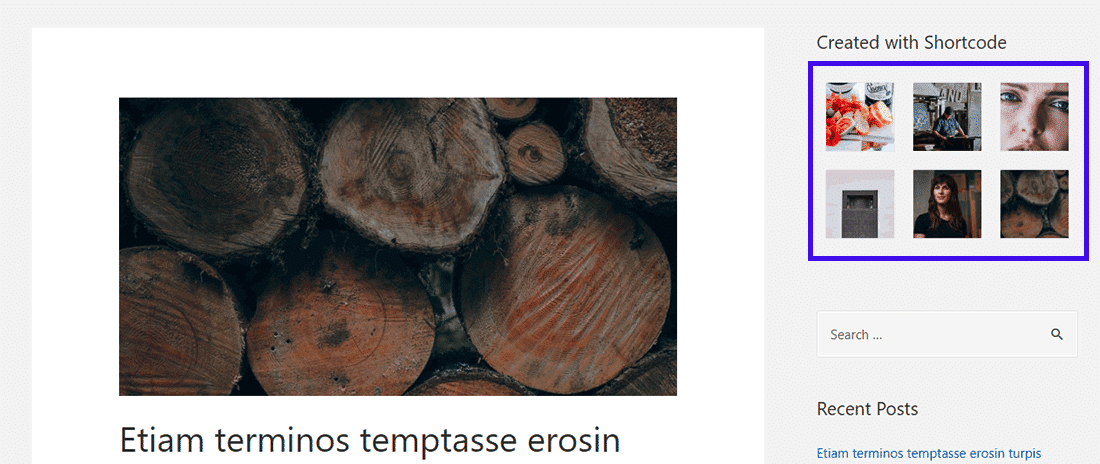
Note: WordPress 4.eight and beneath versions don't support shortcodes in sidebar widgets. Read the Widget Improvements in WordPress 4.9 update for more.
Using WordPress Shortcodes in Header and Footer
WordPress shortcodes are in general meant for pages, posts, and widgets. Merely you have an easy fashion to insert shortcodes anywhere in your site.
Say you want to add a call-to-activity button in your footer, or in all your posts before the comments section. The do_shortcode() callback role comes in handy hither.
You lot need to add the post-obit code to your theme'due south header.php, footer.php, or any of its template files:
<?php echo do_shortcode("[name_of_your_shortcode]"); ?> This will output the shortcode in the identify where you lot inserted the code.
You need to include the square brackets in between the quotation marks to echo the shortcode. Just including its name won't work.
Likewise, you lot can use the do_shortcode() callback part to enable shortcodes anywhere in WordPress, like in the comments department.
A Quick Introduction to the Shortcode API
The WordPress Shortcode API defines how you can use shortcodes to customize and expand your site's functionality. It enables developers to create unique content (e.thousand.. forms, carousels, sliders, etc.) that users can add in their sites by pasting the relevant shortcode.
You lot can add well-nigh any characteristic you can imagine to your website with the aid of shortcodes.
The API supports both cocky-closing and enclosing shortcodes. Information technology handles all the tricky parsing and includes helper functions to set and fetch default attributes.
Thanks to the API, you can dive straight into developing and customizing shortcodes, rather than waste precious time defining regular expressions for every shortcode yous brand.
Understanding the Nuts of Shortcode API
Every time you open a page or postal service in WordPress, it looks for registered shortcodes while processing the site'southward content.
If a registered shortcode is found, the Shortcode API takes over and returns the output of the shortcode(s). The returned output cord replaces the shortcode tag in the location it was added.
You register a shortcode in WordPress with the add_shortcode() role. Here'south how it's done:
add_shortcode( 'shortcode_name', 'shortcode_handler_function' ); -
-
- shortcode_name: The tag WordPress volition look for while parsing post content. The Shortcode API recommends you to use simply lowercase letters, numbers, and underscores to define its value (avoid dashes).
- shortcode_handler_function: The callback function that will be executed later WordPress confirms the presence of a registered shortcode.
-
The shortcode handler office is defined as such:
function shortcode_handler_function( $atts, $content, $tag ){ } -
-
- $atts: An associative array of attributes (i.e. an array of key-value pairs). If you define no attributes, it volition default to an empty cord.
- $content: The enclosed content, if you're defining an enclosing shortcode. Information technology is the responsibility of the handler office to ensure the $content value is returned to the output.
- $tag: The shortcode'south tag value (shortcode_name in the above instance). If two or more shortcodes share the same callback function (which is valid), the $tag value will aid you decide which shortcode triggered the handler function.
-
The API parses the shortcode'southward tag, attributes, and enclosed content (if any) bypassing the values to the handler office, which processes them and returns an output string.
This output cord replaces the shortcode macro on your site's frontend. What you ultimately encounter in the browser is this output.
Where to Add Your Custom Shortcode Scripts?
You can add together your custom shortcode scripts to the theme's functions.php file or include them in a plugin.
If you're adding it to a theme file, you can run the add_shortcode() function every bit is.
But if you're adding it to a plugin, I recommend you to initialize information technology only afterwards WordPress has loaded completely. Yous tin can ensure that by wrapping the add_shortcode() part inside another function. This is called a wrapper office:
function shortcodes_init(){ add_shortcode( 'shortcode_name', 'shortcode_handler_function' ); } add_action('init', 'shortcodes_init'); The add_action() function hooks the shortcodes_init function to burn down only later on WordPress has finished loading (it'southward chosen the 'init' hook).
How to Create a Custom Shortcode in WordPress (Beginner Level)
At present that we've covered the basics, it's time to create a custom shortcode.
Subscribe Now
To follow the steps given below, you need familiarity working with PHP lawmaking and editing your WordPress theme files. Past the fourth dimension you're finished with the tutorial, you'll have your starting time custom WordPress shortcode fix to fire!
We'll start with the simplest shortcode possible, so move towards more than complex ones. Savour your short milestones on your manner to shortcodes mastery!
Check out our video – How To Create Custom Shortcode in WordPress for Beginners:
Example 1: Shortcode Using [current_year]
Let'southward create a shortcode chosen [current_year] that outputs the electric current yr on your website.
This shortcode is helpful if you're adding content to your website that needs to be updated every year. For instance, calculation a copyright discover to your site's footer.
I'll use a barebones plugin to add my shortcode functions. You tin add it to your theme's functions.php file and get the same results, only I don't recommend it. It's OK for testing and learning though!
Allow'southward get started by creating a plugin. Create a new folder in your /wp-content/plugins/ directory.
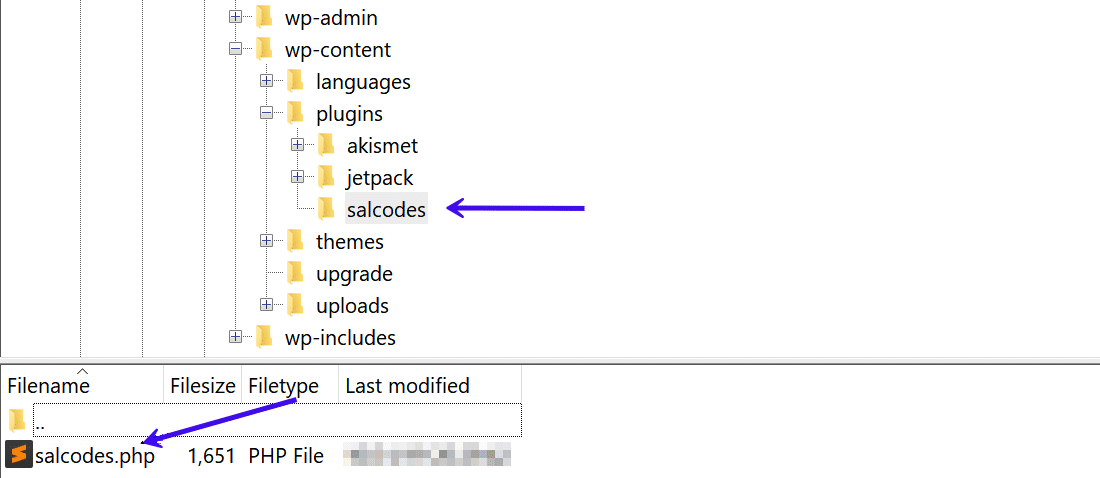
I'chiliad naming my plugin "salcodes" just you can name it anything you want.
In the salcodes plugin directory, create a PHP file with the same proper name ( salcodes.php ). Once washed, add the post-obit header to your plugin'due south file:
<?php /* Plugin Name: Salcodes Version: 1.0 Description: Output the electric current year in your WordPress site. Author: Salman Ravoof Author URI: https://www.salmanravoof.com/ License: GPLv2 or later License URI: https://www.gnu.org/licenses/gpl-2.0.html Text Domain: salcodes */ This unproblematic plugin header is good plenty for our purposes. You can learn more than about plugin header requirements in the WordPress Codex. Save this file, and then go to your WordPress dashboard to activate the plugin.
At present, allow's register the shortcode and its handler role. To exercise that, add the following code to your plugin file:
/** * [current_year] returns the Current Year as a 4-digit cord. * @return cord Current Year */ add_shortcode( 'current_year', 'salcodes_year' ); role salcodes_init(){ function salcodes_year() { return getdate()['year']; } } add_action('init', 'salcodes_init'); /** Ever end your PHP files with this closing tag */ ?> -
-
- @render tag in the PHP annotate defines the type of output returned. It's followed by a curt description of the aforementioned.
- current_year is the shortcode tag or name. This defines the cocky-closing tag you demand to add in your content, which in this example would be [current_year].
- salcodes_year is the proper noun of the shortcode handler function that'll return the output string. We'll define this callback function in the next lines. Since we're creating a simple self-endmost shortcode, you don't have to pass information technology whatever variable values such as $attributes, $content, or $tag.
- salcodes_init is the wrapper function that is hooked to 'init' to brand sure that the shortcode is registered and run merely later on WordPress has finished loading. WordPress' inbuilt add_action() function makes this possible.
- getdate() is a PHP role that returns an array of date information of the electric current timestamp. The year key holds the current year's value (as a iv-digit string). So, getdate()['year'] returns the current year. This output is exactly what we desire.
-
Relieve your plugin file. It's now time to examination whether the shortcode works as intended.
Add the shortcode anywhere in your site (page, post, sidebar widget, etc.). I'1000 adding information technology to my site'due south sidebar Text widget.
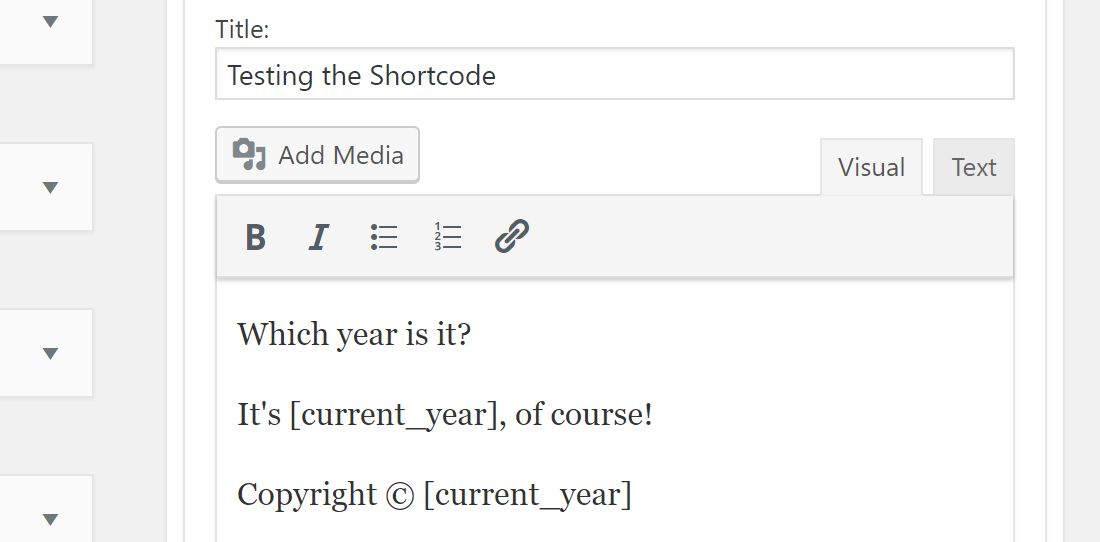
And as expected, it works perfectly.
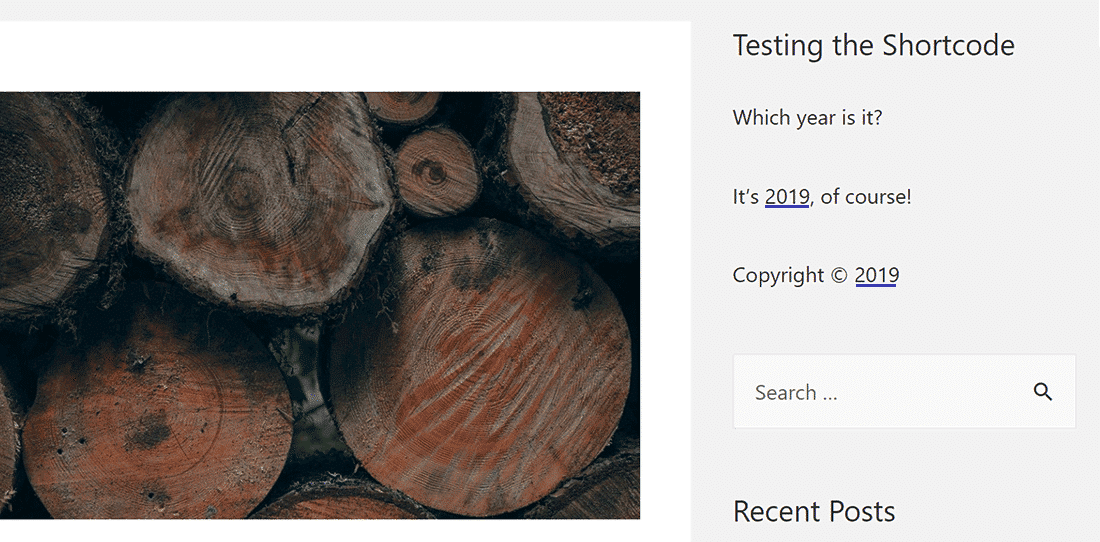
Congrats on reaching your first milestone!
The shortcode you just created doesn't have any $attributes or $content variables associated with it. Y'all'll learn how to use them in the post-obit examples.
Example 2: Shortcode for a CTA Push button
Permit'south create a customizable CTA Button shortcode. This will be self-endmost as well (sad $content, y'all need to hold on till the next one).
I desire users to be able to customize the CTA Button's size and color with the shortcode attributes.
Since the final output is a button chemical element, its HTML attributes such equally href, id, course, target & label can be used to customize it with ease.
You lot can utilise the id and class attributes to style the push button since they're both common CSS selectors.
I'm not wrapping my handler function here to keep things simple to explain.
/** * [cta_button] returns the HTML lawmaking for a CTA Button. * @return string Button HTML Code */ add_shortcode( 'cta_button', 'salcodes_cta' ); function salcodes_cta( $atts ) { $a = shortcode_atts( array( 'link' => '#', 'id' => 'salcodes', 'color' => 'blue', 'size' => '', 'characterization' => 'Push button', 'target' => '_self' ), $atts ); $output = '<p><a href="' . esc_url( $a['link'] ) . '" id="' . esc_attr( $a['id'] ) . '" course="button ' . esc_attr( $a['color'] ) . ' ' . esc_attr( $a['size'] ) . '" target="' . esc_attr($a['target']) . '">' . esc_attr( $a['label'] ) . '</a></p>'; return $output; } Woah, there'southward a lot to unpack here. I'll go to explain information technology line-past-line, so y'all can understand how it works.
-
-
- We've covered add_shortcode() part and how it works in the previous section.
- shortcode_atts() is a WordPress function that combines user shortcode attributes with known attributes. It fills in default values when needed (which you lot tin can set yourself too). The result volition be an array containing every key from the known attributes, merged with values from user-defined shortcode attributes.
- Within the shortcode handler part, nosotros define a variable ($a) and assign it to the assortment returned by shortcode_atts(). We assign the attributes their default values with the syntax: 'attribute' => 'default-value'. For example, in the to a higher place lawmaking, we're setting the default value of attribute label to Push with the syntax 'label' => 'Push'.
- We can excerpt the values for each attribute central with the PHP syntax for arrays: $a['attribute'].
- The $output variable stores the HTML code of the button element (<a> tag with 'button' course). It's the cord that's finally returned by the function.
-
If y'all want to set the default link to be the site's homepage URL, you can make use of the home_url() WordPress function.
Let's try using the shortcode as is, with no attributes defined, and encounter what's outputted.
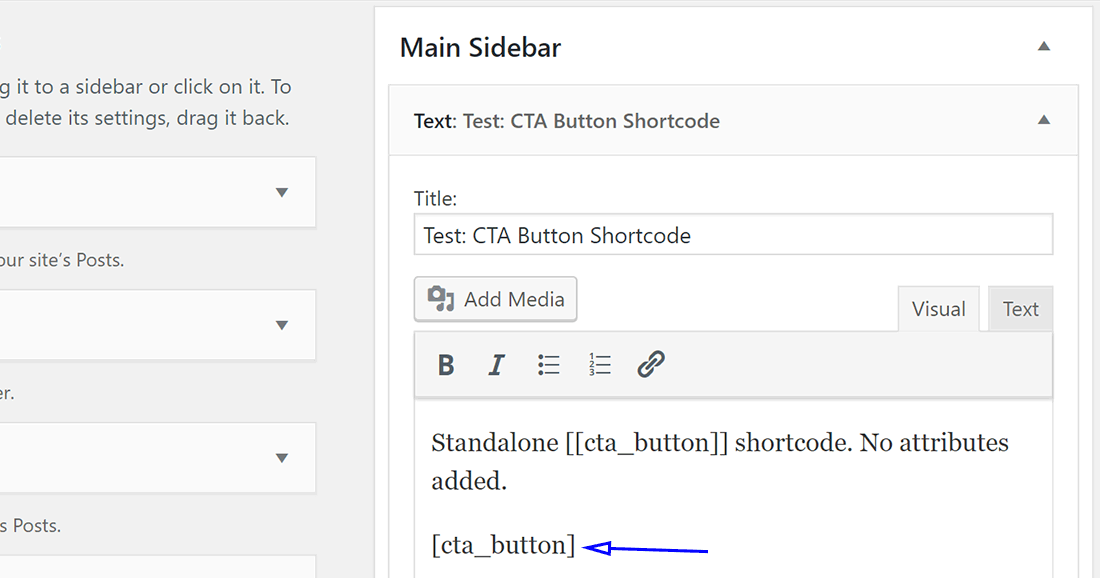
If y'all're wondering what the double foursquare brackets are for ([[cta_button]]), they're chosen an escaping shortcode. They help yous output any registered shortcode in your site equally regular text, like in the flick below.
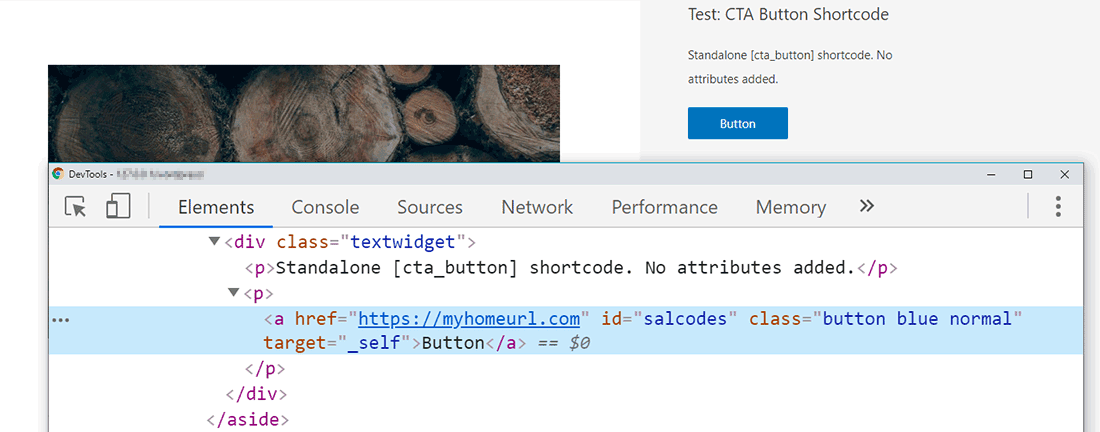
Users tin can customize the size and color of the button with the shortcode. We already gear up their default values in the handler part, but we demand to register and enqueue the stylesheet to the list of available resource. This stylesheet should have all the classes divers in the shortcode.
You tin set these classes in your theme'due south global stylesheet also, but it'southward recommended to load them separately. This ensures that even if yous change or update your WordPress theme, these classes will still load along with the shortcode.
/** Enqueuing the Stylesheet for the CTA Button */ function salcodes_enqueue_scripts() { global $post; if( is_a( $post, 'WP_Post' ) && has_shortcode( $mail->post_content, 'cta_button') ) { wp_register_style( 'salcodes-stylesheet', plugin_dir_url( __FILE__ ) . 'css/style.css' ); wp_enqueue_style( 'salcodes-stylesheet' ); } } add_action( 'wp_enqueue_scripts', 'salcodes_enqueue_scripts'); The salcodes_enqueue_scripts() function defines the $post global variable, and so confirms two atmospheric condition via:
-
-
- is_a() : checks whether $post is an instance of the WP_Post object. It'south referring to all the mail service types in WordPress.
- has_shortcode() : checks whether the mail service content contains the [cta_button] shortcode.
-
If both conditions are true, the function registers and enqueues the mode.css stylesheet included in the CSS folder. The plugin_dir_url( $file ) function makes it easy to get the URL of the plugin's directory.
I won't show you the CSS code hither, but you lot can notice it in the source code linked at the terminate of this section.
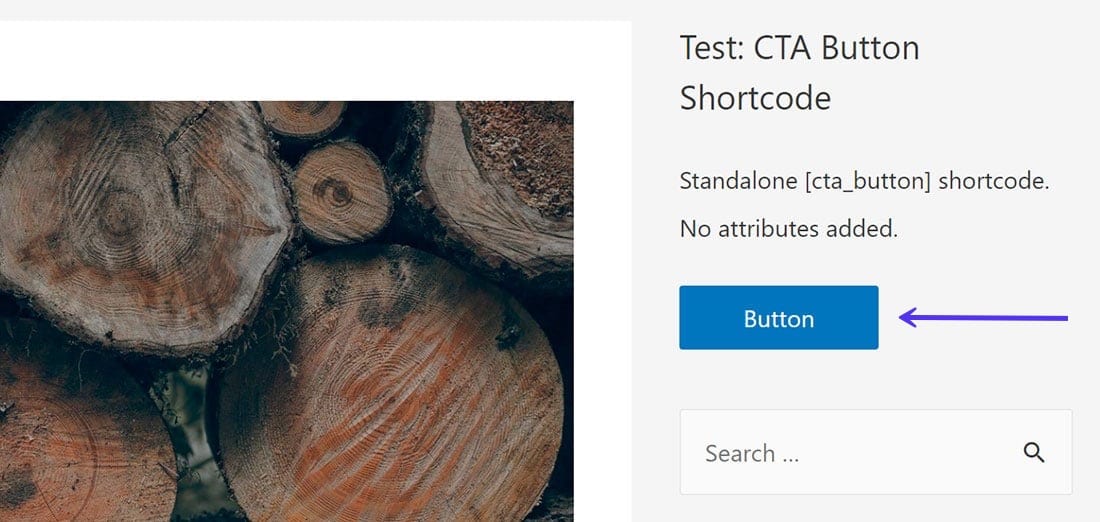
Finally, allow's exam the [cta_button] shortcode by adding it to the post content:
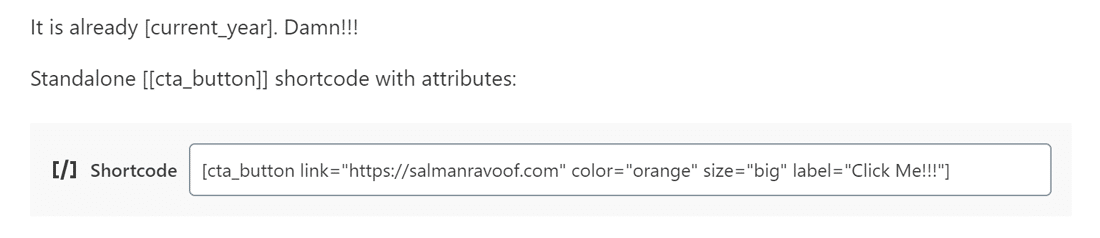
The epitome below shows how the CTA Button looks on the frontend:

Now that y'all've learned how to define custom attributes and include styles, you can add various other functionality to your CTA Button shortcode. For instance, you can give your users the selection to add together animations, hover effects, and diverse other button styles.
Example 3: Shortcode Using $content
For our final instance, let's build an enclosing shortcode called [boxed] that outputs any content between its tags in a box with colorful titles.
Let'southward go started by registering the shortcode and defining its handler role.
/** * [boxed] returns the HTML code for a content box with colored titles. * @render string HTML code for boxed content */ add_shortcode( 'boxed', 'salcodes_boxed' ); function salcodes_boxed( $atts, $content = zippo, $tag = '' ) { $a = shortcode_atts( assortment( 'title' => 'Title', 'title_color' => 'white', 'color' => 'blue', ), $atts ); $output = '<div class="salcodes-boxed" fashion="border:2px solid ' . esc_attr( $a['color'] ) . ';">'.'<div form="salcodes-boxed-title" style="background-color:' . esc_attr( $a['color'] ) . ';"><h3 fashion="color:' . esc_attr( $a['title_color'] ) . ';">' . esc_attr( $a['title'] ) . '</h3></div>'.'<div class="salcodes-boxed-content"><p>' . esc_attr( $content ) . '</p></div>'.'</div>'; return $output; } -
-
- $content = nix : this registers the shortcode as an enclosing blazon. You can utilize the $content variable inside your handler function to modify your output as you wish.
- $tag = " : this defines the shortcode's $tag variable. It's non necessary in this example, just it's a skilful practice to include it.
-
In this example, nosotros change the content using inline CSS styles.
Styles for any classes used inside the shortcode are registered and enqueued as we did in the previous shortcode example.
But having two shortcodes use the aforementioned stylesheet means that yous have to load it if either of them is used. So, allow'south update the salcodes_enqueue_scripts() function:
/** Enqueuing the Stylesheet for Salcodes */ role salcodes_enqueue_scripts() { global $post; $has_shortcode = has_shortcode( $mail service->post_content, 'cta_button' ) || has_shortcode( $post->post_content, 'boxed' ); if( is_a( $mail service, 'WP_Post' ) && $has_shortcode ) { wp_register_style( 'salcodes-stylesheet', plugin_dir_url( __FILE__ ) . 'css/style.css' ); wp_enqueue_style( 'salcodes-stylesheet' ); } } add_action( 'wp_enqueue_scripts', 'salcodes_enqueue_scripts'); -
-
- $has_shortcode: a user-defined variable that checks whether either of the shortcodes exist on the page/post. The || (OR operator) makes that possible.
-
Now, let'due south take our [boxed] shortcode for a spin.
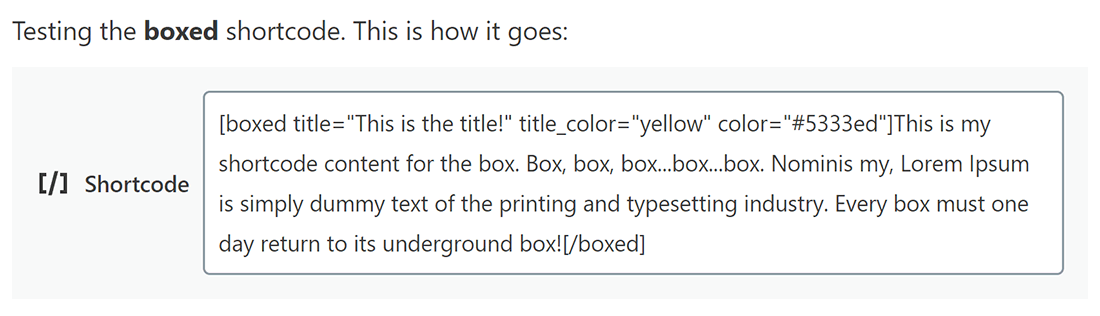
The screenshot below shows the output nosotros get.
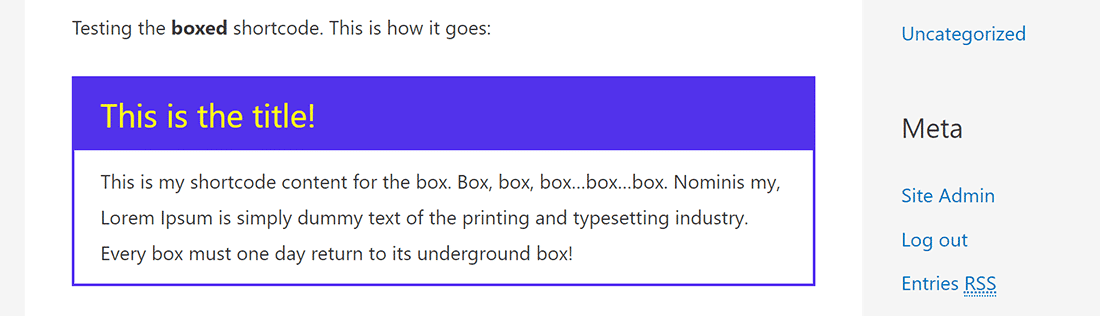
Now that yous've learned how to make your ain shortcodes, y'all can think out of the [box] and requite them your own spin. Don't forget to share your creations with u.s.a.!
If you want, y'all can download the Shortcode Plugin source lawmaking from hither.
WordPress Shortcodes: Pros vs Cons
The Pros
-
-
- Shortcodes simplify the add-on of complex features in WordPress sites. You lot can add together about anything past typing a single line of code.
- Shortcodes automate the development workflow. They eliminate the need to write complex scripts every time yous want to insert a sure feature.
- Shortcodes are more user-friendly than adding HTML code or PHP scripts.
- Shortcodes tin can exist bundled within plugins. Even if you update WordPress or change/update your theme, the shortcodes will still be valid and continue to work every bit they did before.
- Bundling shortcodes inside plugins makes them piece of cake to use across multiple WordPress websites. If you're a programmer handling many sites, having all your custom shortcodes prepare to go is a lifesaver.
- Since shortcodes also accept attributes, users can alter how the same shortcode behaves by simply altering its attribute options.
-
The Cons
-
-
- Shortcodes aren't intuitive to use for the finish user, especially if a lot of them are used on a folio. In such cases, they're more than suited for developers.
- Information technology's hard to tell what a shortcode does just past looking at it. The WordPress core team has aptly named them "mystery meat embed codes" for this verbal reason.
- Shortcodes that come arranged with themes will stop working if you modify your theme.
- Shortcodes are ambiguous regarding their syntax. For case, some of them support optional closing, so you lot can apply them as either self-endmost or enclosing or even both if they're nested. You lot can gauge how it can go super confusing super fast.
- Shortcodes can break HTML due to alien tags or interoperability issues. It's never a good sight to see them on any site's frontend.
- Shortcodes add together an extra load on your server. As the number of shortcodes on your folio/posts increases, so does this load. Too many shortcodes tin can bring your website to a crawl (e.g. the output by most page builders).
-
Shortcodes and Gutenberg Blocks
Introducing Gutenberg reduced the desirability of shortcodes. Users can now add blocks straight from the editor interface, rather than deal with shortcode markups, no thing how simple it is.
And if you want to add together shortcodes, Gutenberg even comes with a dedicated block to add shortcodes. Blocks are the new Shortcodes.
"If you could do it with a shortcode, you tin practice it every bit a cake." — James Huff, Happiness Engineer at Automattic
That explains why all the popular shortcodes are being converted to blocks. Many WordPress developers take shifted towards making their products and services work exclusively with the block editor (Gutenberg).
But that doesn't hateful it'due south the finish of the earth for shortcodes. The WordPress core team has promised many improvements to the block editor, which y'all could see in Xx Xx, but until then, shortcodes are here to stay!
Summary
Adding circuitous functionality anywhere to your WordPress site is easy with shortcodes. They give users easy-to-type tags that can be used without worrying almost dabbling with complex codes.
While in that location may be no shortcuts in life, there sure are many shortcodes to apply in WordPress. My favorites are Shortcodes Ultimate and Shortcodes by Angie Makes.
And if you can't find the ane you're looking for, you can create 1 yourself.
You lot tin even take a shortcut to create your custom shortcode past using the Shortcoder plugin. It takes care of all the essentials for you. And think: life is short, use shortcodes!
Save time, costs and maximize site performance with:
- Instant help from WordPress hosting experts, 24/7.
- Cloudflare Enterprise integration.
- Global audience reach with 29 data centers worldwide.
- Optimization with our built-in Awarding Performance Monitoring.
All of that and much more, in one plan with no long-term contracts, assisted migrations, and a 30-day-money-dorsum-guarantee. Check out our plans or talk to sales to find the plan that's right for y'all.

How Do I Find What Shortcodes Are In A Template,
Source: https://kinsta.com/blog/wordpress-shortcodes/
Posted by: browningfroppres.blogspot.com
0 Response to "How Do I Find What Shortcodes Are In A Template"
Post a Comment